Motorized shades are closer to a default for Delray Beach renovations and new builds in 2026 than they are to a luxury upgrade. Here is everything you need to know before you decide.
How they work. Battery vs hardwired. Alexa, Google, Lutron, Control4. Fabric choices. What they cost. And who installs them in Delray Beach.
If you have been looking at motorized shades for your Delray Beach home and feel like you need a degree to understand the options, that is not your fault. The motorized shade category has exploded in the last three years and the information available online is either too broad to be useful or written by a national retailer who has no idea what your specific windows, sun exposure, or smart home setup actually look like.
This guide is written specifically for Delray Beach homeowners. It covers everything you need to make an informed decision — how motorized shades work, the difference between battery and hardwired power, which smart home platforms actually integrate with which systems, what fabrics make sense for South Florida's UV environment, and what the full process looks like from consultation to installation. No upselling, no vague non-answers, no redirects to a national call center.
How Motorized Shades Actually Work
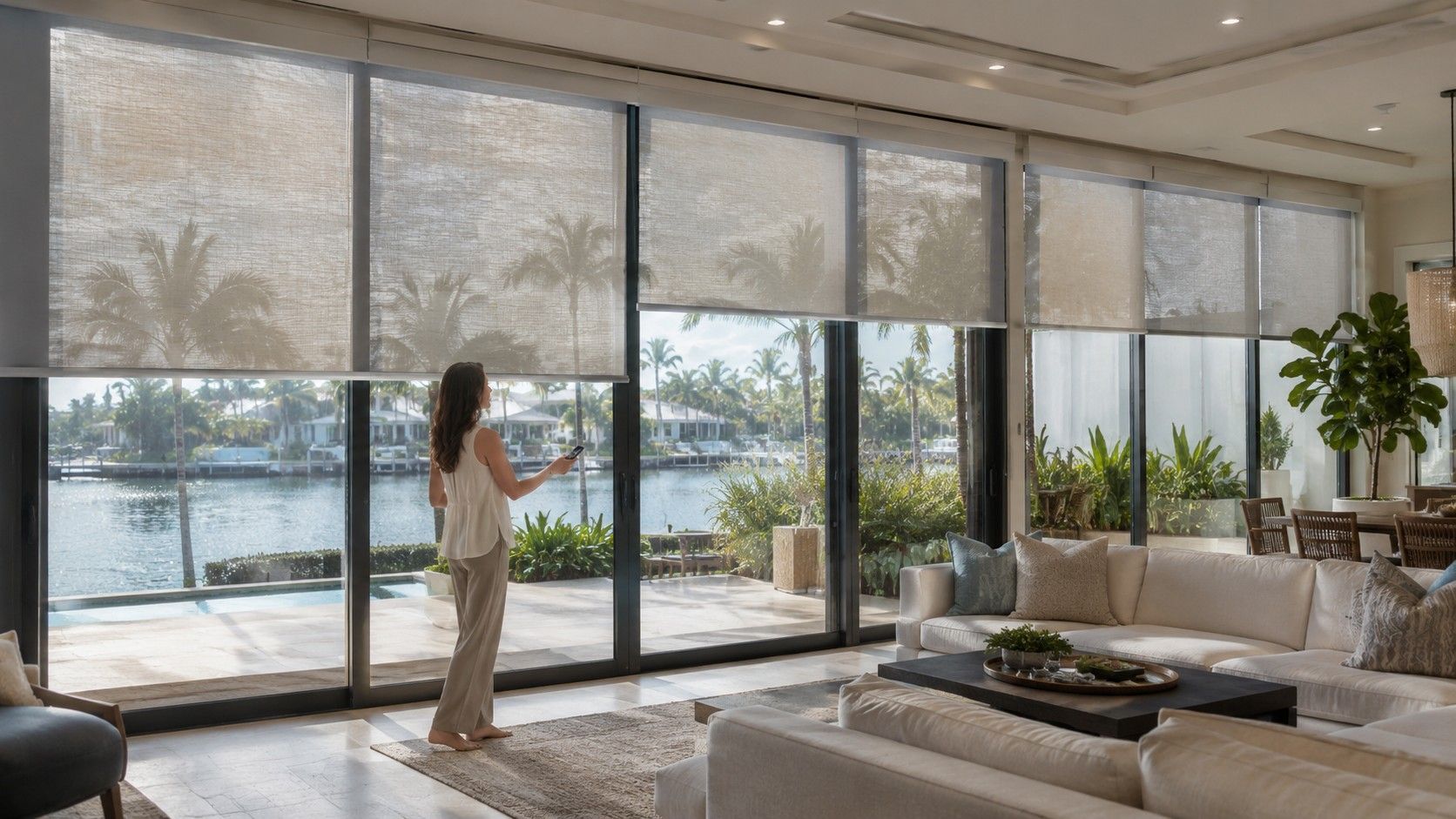
A motorized shade is a standard roller shade with one addition: a compact electric motor housed inside the headrail at the top of the window. The motor raises and lowers the shade via an internal drive mechanism — quietly, precisely, and without cords of any kind. The shade itself looks identical to a non-motorized roller shade when installed. The difference is entirely in how it operates.
Control options range from a basic handheld remote — which works exactly like a television remote, no setup required — to a wall switch, a smartphone app, voice commands via Alexa or Google Home, or fully automated schedules that respond to time of day, sunrise and sunset, or integration with your existing home automation system. Every control option is available on the same motor. You choose which ones you use.
The automation capability is what makes motorized shades genuinely transformative for a Delray Beach home rather than just a convenience upgrade. A shade that closes at 11 AM every day before peak heat hits your west-facing windows, and opens again at 6 PM when the sun has moved off the glass, is providing UV protection and AC load reduction every single day — including days when you are not home. A manual shade you intend to close every afternoon at 11 AM will not actually get closed every afternoon at 11 AM. The motorized shade on a timer will.
"The value of motorized shades in a Delray Beach home is not the remote control. It is the automation. The shade that works whether you remember it or not."
Battery vs Hardwired — Which Is Right for Your Home
This is the question that creates the most confusion and the most unnecessary hesitation. The answer is simpler than the category makes it seem.
Battery-Powered Motorized Shades
Right for most Delray Beach retrofits- No electrical work required
- No wiring, no wall modification
- Installs like a standard shade
- Rechargeable via USB-C
- 6 to 12 months per charge
- Full smart home integration
- Available on any window size
- Right for existing homes
Hardwired Motorized Shades
Right for new construction and major remodels- Low-voltage wiring inside the wall
- Never needs recharging
- Electrician required for wiring
- Preferred for luxury installations
- Higher motor torque for large shades
- Full smart home integration
- Best for new construction
- Ideal for major remodels
For the vast majority of Delray Beach homeowners working with existing homes — which is most of the market — battery-powered motorized shades are the correct choice. No electrician. No contractor. No disruption to walls or ceilings. The installation looks and operates identically to a hardwired system. The only difference is a recharge every 6 to 12 months via a USB-C cable, which takes about 4 hours and is no more inconvenient than charging a phone.
Hardwired systems make sense if you are building new, doing a major renovation where walls are open anyway, or if you have very large or very heavy shades that require higher motor torque than a battery system provides. For most Delray Beach retrofit installations, hardwired is not necessary and the additional cost and disruption is not justified by the incremental benefit.
Smart Home Integration — What Works With What
If you have any smart home technology in your Delray Beach home already — an Amazon Echo, a Google Home speaker, Apple HomeKit, a Lutron lighting system, a Control4 or Crestron system — your motorized shades can integrate directly into what you already have. Here is what each platform actually does:
Amazon Alexa
Voice commands. "Alexa, lower the living room shades." Works via the shade manufacturer's Alexa skill. No additional hardware required in most cases.
Google Home
Voice commands via Google Assistant. "Hey Google, open the bedroom shades." Same integration approach as Alexa via the manufacturer's Google Home action.
Apple HomeKit
Native integration with Apple Home app on iPhone, iPad, and HomePod. Siri voice control. Supports Home automations tied to time of day, location, and scenes.
Lutron Caseta
The most seamless integration for homes already on Lutron lighting. Shades and lights share the same app, same keypads, same scenes. Pico remotes control both.
Lutron RadioRA
Premium whole-home Lutron platform. Shades integrate into full RadioRA scenes — Good Morning, Away, Entertain — alongside lighting and HVAC. Preferred for luxury Delray Beach homes.
Control4 / Crestron
Enterprise-grade home automation. Shades become part of multi-room scenes with full programming flexibility. Standard in Addison Reserve, Mizner Country Club, and high-end custom builds.
The key thing to know about smart home integration is that it needs to be planned before installation, not retrofitted afterward. If your home runs on Lutron, the motorized shade motor needs to be selected for Lutron compatibility at the order stage. If you have Control4, the same applies. This is why the consultation step matters — figuring out your existing smart home ecosystem and specifying the right motor for it is a decision that happens before anything is ordered, not after the shades arrive.
No smart home system at all? That is completely fine. A motorized shade with a basic handheld remote works exactly as advertised with no additional setup, no hub, no app required. The remote that comes in the box controls the shade. Full stop. Smart home integration is available whenever you want it — adding Alexa or Google Home later requires only the manufacturer's app and a skill enable. It is not a now-or-never decision at installation.
Fabric Choices — What Matters in Delray Beach Specifically
The motor is the mechanism. The fabric is the product. And in Delray Beach's coastal UV environment, fabric specification is where the long-term performance difference between a good installation and a poor one is actually made.
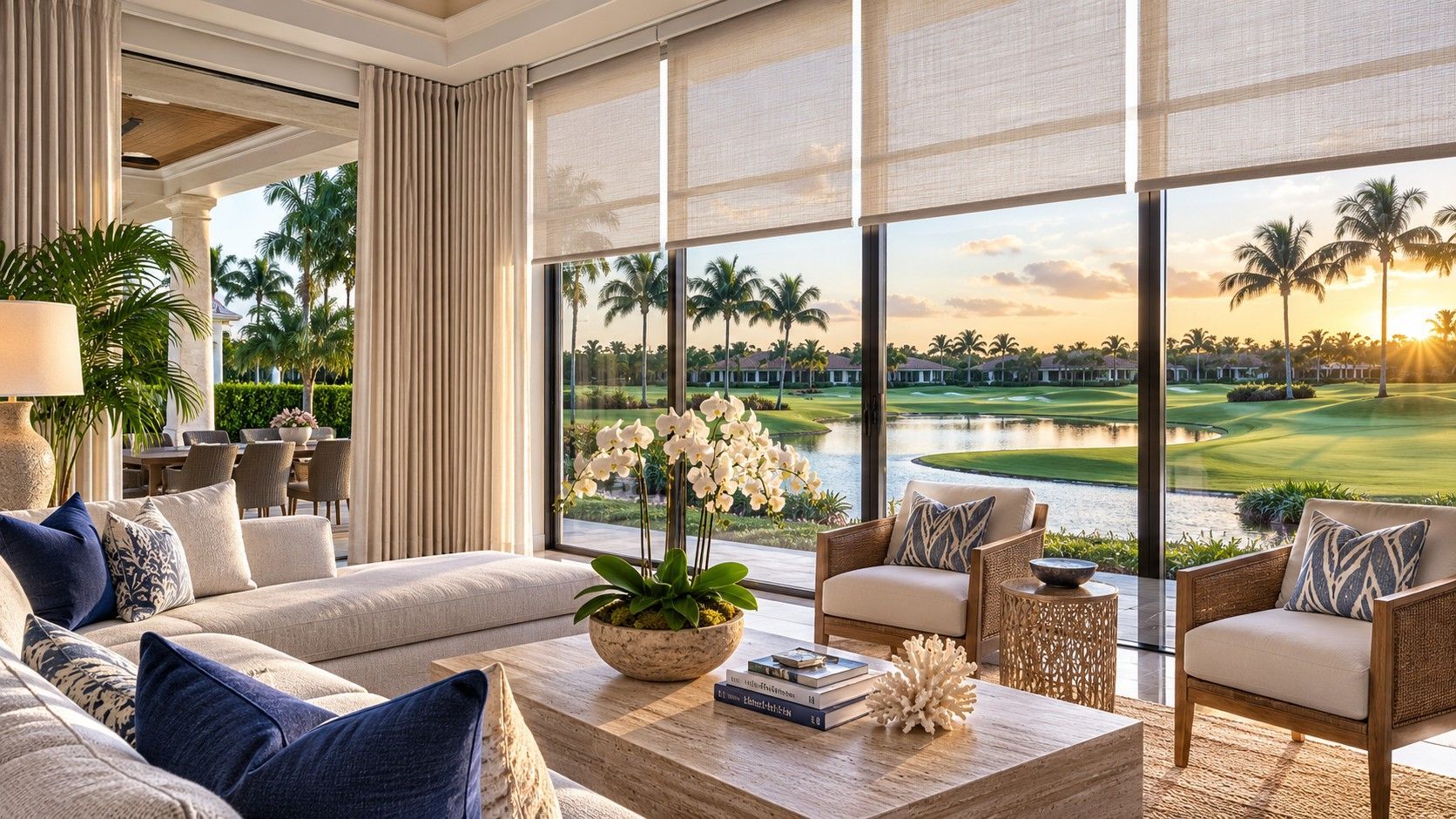
Solar shades — the default for most rooms. Solar shade fabric is woven mesh engineered specifically to filter solar radiation. The openness factor — the percentage of the weave that is open versus solid — controls how much light passes through. A 3% openness factor blocks the most solar heat and glare while maintaining a view. A 5% openness factor provides strong heat reduction with a slightly more open feel. A 10% openness factor is appropriate for rooms where heat reduction is less critical and more natural light is preferred. For Delray Beach homes, 3% to 5% is the standard specification on west and south-facing windows.
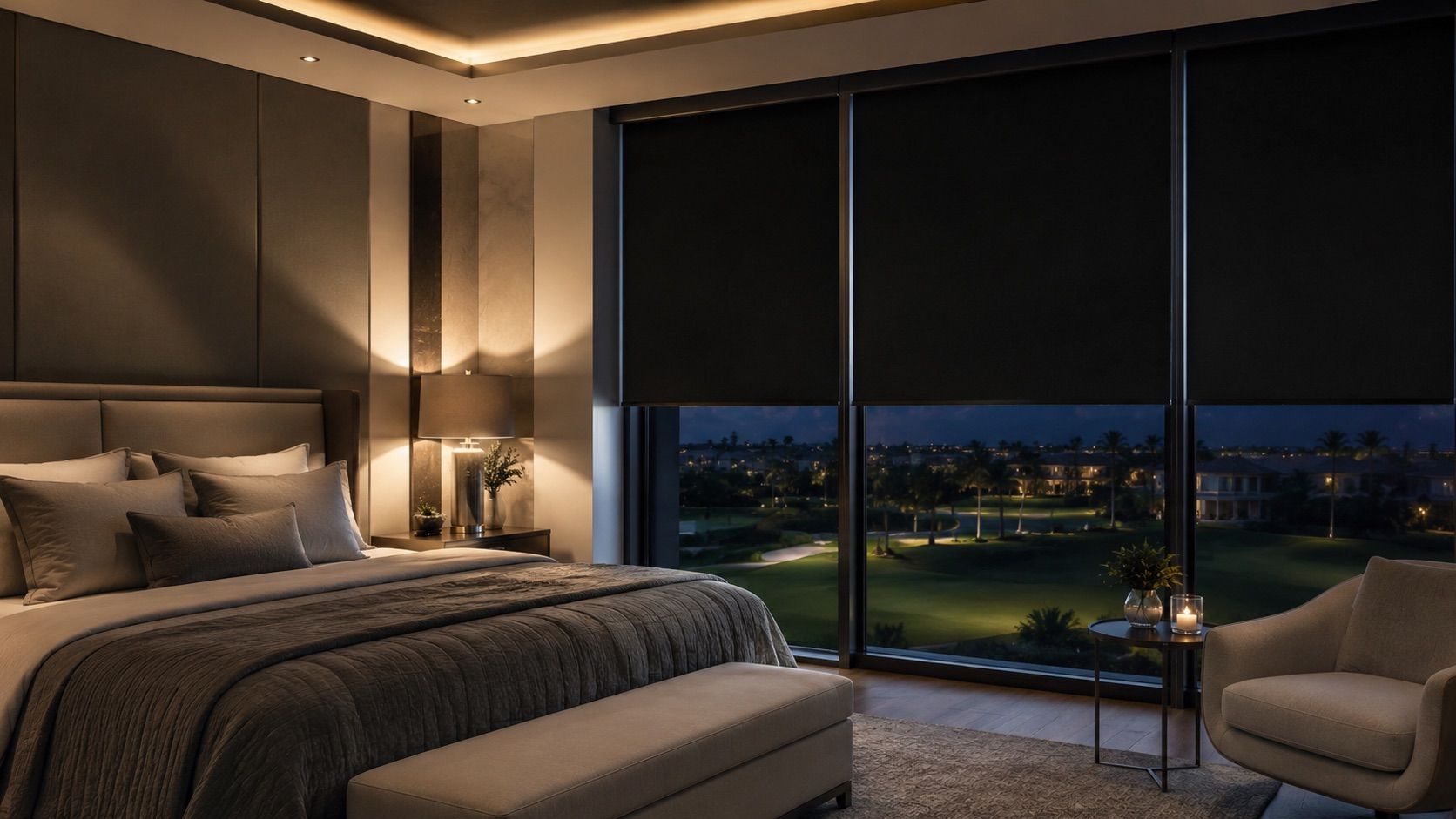
Blackout — for bedrooms and media rooms. Blackout fabric blocks 100% of light. Nothing passes through and the edges are sealed against the frame. The correct specification for master bedrooms where Florida's early sunrise is a problem, and for any room used as a home theater or media room. Available in motorized versions with all the same smart home integration as solar shades.
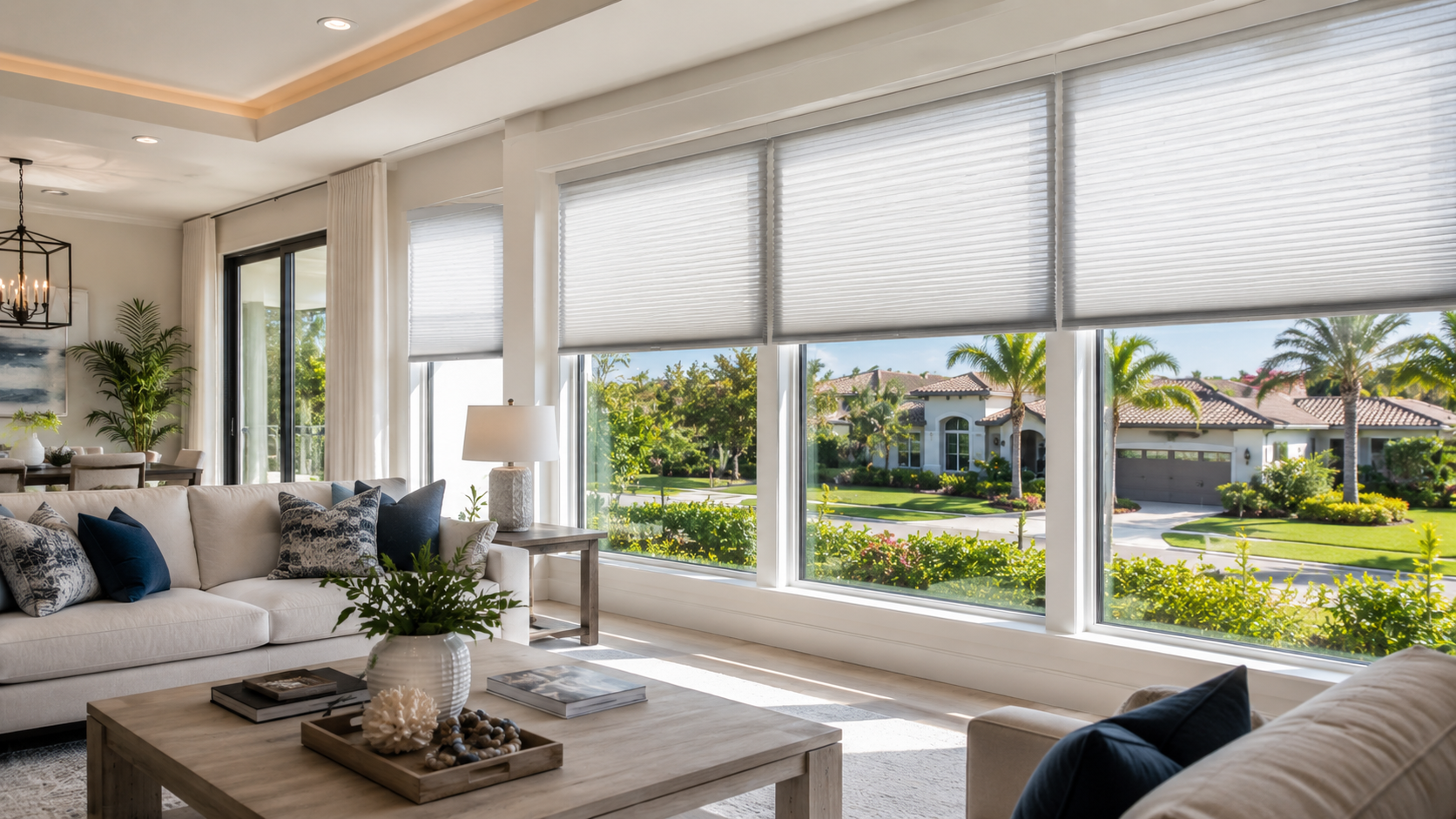
Light filtering — for rooms where full blackout is not needed. Light filtering fabrics reduce visible light without blocking it completely. They provide privacy during the day — you can see shadows from outside but not clearly into the room — while maintaining a softly lit interior. Appropriate for living rooms, dining rooms, and spaces where ambient light is desirable without glare or direct sun.
The fabric specification that matters most in Delray Beach: Regardless of openness factor, every fabric installed in a coastal South Florida home should be solution-dyed and UV-stabilized. Solution-dyed means the colorant is built into the fiber during manufacturing — not applied to the surface afterward. Surface-dyed fabrics visibly yellow and fade within one to two seasons in direct Atlantic sun. Solution-dyed fabrics maintain their color and UV-blocking performance for the full rated lifespan of the shade. Ask your installer specifically which specification the fabric carries. A reputable local installer will know immediately. A vague answer is a red flag.
The Florida-Specific Case for Motorized Automation
The energy efficiency argument for motorized shades is more compelling in Delray Beach than in almost any other market in the country. Here is why. The Department of Energy has documented that up to 30% of residential cooling energy is attributable to heat gain and loss through windows. In a climate where air conditioning runs for ten to eleven months of the year and peak afternoon temperatures push indoor temperatures significantly before the AC can compensate, that percentage is not abstract — it represents hundreds of dollars annually in a typical Delray Beach home.
A motorized solar shade programmed to close on west-facing windows before peak sun hits — automatically, every single day, whether you are home or traveling — intercepts that solar heat gain before it enters the room. Your AC starts from a lower baseline. It runs less. The floors and furniture that were absorbing UV for years without protection stop absorbing it. The benefits are real, measurable within the first billing cycle after installation, and compound over the full lifespan of the shade.
The automation is the critical element. A manual shade that is theoretically available to be closed every afternoon at noon will not get closed every afternoon at noon. Human behavior does not work that way. A motorized shade on a timer does. Every single day.
What the Process Looks Like — Start to Finish
The free in-home consultation is where everything starts. Scott Smith comes to your Delray Beach home with fabric samples, assesses every window and its sun exposure, asks about your existing smart home setup, and gives you an honest recommendation for each window — solar shade vs blackout, battery vs hardwired, openness factor, and which smart home integration path makes sense for your home. The consultation takes 45 minutes to an hour for a full home. You leave with an exact quote and a clear picture of what goes where and why.
Once you approve the order, your shades are custom-fabricated with your specified motor, fabric, and dimensions. Lead time is typically 3 to 5 weeks depending on the manufacturer and current order volume. Installation takes one day for a standard Delray Beach home. Smart home pairing and programming — connecting to Alexa, Google Home, Lutron, or whichever platform is in your home — is completed during the same installation visit. We test every shade before we leave and walk you through operation.
If anything needs adjustment after installation — a schedule change, a scene update, a pairing issue — you call the same number and reach the same person who installed the shades. No customer service queue, no ticket system, no call center in another state.
Why the Local Installer Matters More With Motorized Shades
Motorized shades are not a complicated product but they are a system — motor, fabric, headrail, mounting hardware, smart home integration, and programming all working together correctly. When one element is wrong, the whole system underperforms. And unlike a standard shade where a measurement error is immediately obvious, a motorized shade that is slightly misspecified for your smart home setup, or whose motor is not rated for the fabric weight it is carrying, reveals its problems gradually over months of use.
The local installer advantage with motorized shades is accountability. When Scott Smith installs your motorized shades in Delray Beach, he knows your windows, your smart home setup, your schedule, and how each room is used. If something is not right — and in a custom installation, something occasionally needs adjustment — you call him directly. There is no franchise system, no subcontractor network, no escalation process. The person who installed the shades is the person who stands behind them.
Surfside Blinds installs motorized window treatments throughout Delray Beach, Boca Raton, Boynton Beach, Highland Beach, Gulf Stream, Lake Worth Beach, and Ocean Ridge. Every consultation is handled personally by Scott Smith. Free in-home consultation with no obligation to purchase.